
Last copy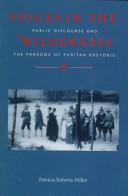
From the collection
Voices In The Wilderness: Public Discourse And The Paradox Of Puritan Rhetoric: public discourse and the paradox of Puritan rhetoric
5.000 KD
Condition
What has gone wrong with discourse and deliberation in the United States? It remains monologic, argues Patricia Roberts-Miller in Voices in the Wilderness, which traces America’s dominant form...
◆ Ships from Kuwait
◆ KNET · Apple Pay · Cash on Delivery
◆ Wrapped with care for collectors
Details
AuthorPatricia Roberts-Miller
Printed1999
Era1980–1999
PublisherUniversity Alabama Press
LanguageEnglish
FormatHardcover
ConditionFine
Reference13880236-fine
The Story
What has gone wrong with discourse and deliberation in the United States? It remains monologic, argues Patricia Roberts-Miller in Voices in the Wilderness, which traces America’s dominant form of argumentation back to its roots in the rhetorical tradition of 17th-century American Puritans. A work of composition theory, rhetorical theory, and cultural criticism, this volume ultimately provides not only new approaches to argumentation and the teaching of rhetoric, composition, and communication but also an original perspective on the current debate over public discourseBoth Jürgen Habermas and Wayne Booth—two of the most influential theorists in the domain of public discourse and good citizenry—argue for an inclusive public deliberation that involves people who are willing to listen to one another, to identify points of agreement and disagreement, and to make good faith attempts to validate any disputed claims. The Puritan voice crying in the wilderness, Roberts-Miller shows, does none of these things. To this individual of conscience engaged in a ceaseless battle of right and wrong against greedy philistines, all inclusion, mediation, and reciprocity are seen as evil, corrupting, and unnecessary. Hence, the voice in the wilderness does not in any real sense participate in public deliberation, only in public pronouncement.Arguing that our culture’s continuing affection for the ethos of the voice crying in the wilderness is one of our more troubling inheritances from the early American ambivalence to public discourse—including the Puritan denigration of rhetoric—Roberts-Miller contends that the monologic discourse of the Puritans in fact contains within it arguments for dialogism. Thus, the history of rhetoric can provide much richer fields for reimagining discourse than heretofore credited. Roberts-Miller concludes by extending her findings into their practical applications for argumentation in the public sphere and in the composition classroom.More from American History
See all 356 books Last copy
Watchdogs Of Democracy?: The Waning Washington Press Corps And How It Has Failed The Public
5.000 KD
 Last copy
Visions Of Technology: A Century Of Vital Debate About Machines Systems And The Human World (The Sloan Technology Series): a century of vital debate about machines, systems, and the human world
7.250 KD

We Are Our Mothers' Daughters
3.000 KD
Valley Forge: (Social Studies 07)
Valley Forge: (Social Studies 07)
2.500 KD
 Last copy
Big Blues: The Unmaking Of IBM
6.250 KD
 Last copy
Heaven And Hell
10.750 KD
 Last copy
Required Reading
4.250 KD
 Last copy
The Greatest Game: The Yankees, The Red Sox, And The Playoff Of '78
5.000 KD