
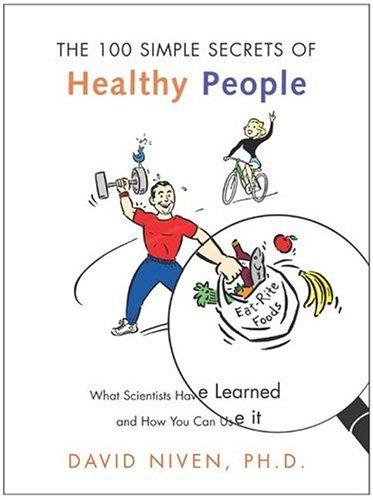
tHE 100 Simple Secrets Of Healthy People: What Scientists Have Learned And How You Can Use It (100 Simple Secrets)
The Simple Science of a Healthy Life From fitness to diets to emotional health and longevity, what do people who feel and look healthy do differently than those...
Details
The Story
The Simple Science of a Healthy Life From fitness to diets to emotional health and longevity, what do people who feel and look healthy do differently than those who are overtired, depressed, or out of shape? Every day we face an avalanche of studies and statistics that tell us what we should or shouldn't eat, how long we need to exercise, or how to protect ourselves from secondhand smoke and the harmful rays from the sun. Not only are these studies often contradictory, but the actual scientific information is usually inaccessible. Moving beyond the myths and misinformation, the advice in these pages is not based on one person's opinions or one expert's study. For the first time the research available on the health of average Americans has been distilled into one hundred essential ways that we can become healthier and happier. Each of the core findings is accompanied by a real life example showing these results in action. Eat more often. Oxford University researchers found that people who ate five or six times a day had a 5 percent lower total cholesterol than average and were 45 percent more likely to be able to sustain their target weight than people who ate once or twice a day. Who says caffeine is bad for you? The majority of scientific evidence shows that, for a healthy adult, moderate quantities of caffeine (about three cups of coffee per day) pose no significant health risks. Home sweet home. People who described their home lives as satisfying were 24 percent more likely to live beyond normal life expectancy, according to a UCLA study.
More from Fitness & Wellness
See all 1,076 books Last copy
 Last copy
 Last copy
 Last copy
 Last copy